
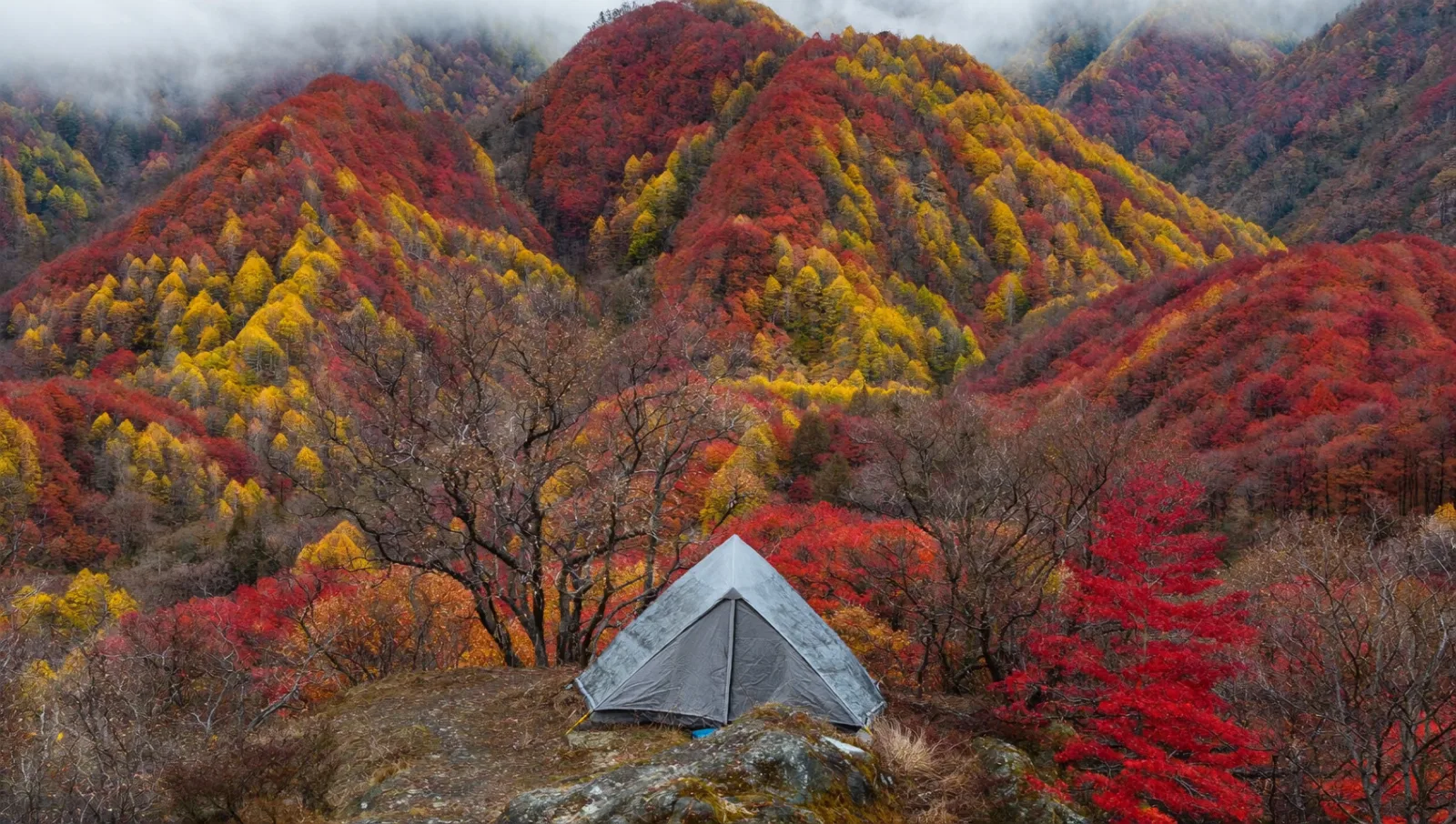
Every autumn, travellers arrive at a famous spot to find the maples either stubbornly green or already brown on the ground, and conclude they were unlucky. They were not unlucky. They treated koyo — the turning of the leaves — as a fixed date, when it is actually a moving front that sweeps down Japan's mountains on a schedule you can read and plan around.
Get the model right and autumn stops being a gamble. You can position yourself to sit inside peak colour not for a single lucky weekend but for two weeks or more, simply by moving with the front instead of chasing it.

Koyo is a front, not a day
Leaves turn in response to falling temperature — specifically, cool nights are the trigger. Because temperature falls with both altitude and latitude, the colour appears first where it gets cold first: on the high peaks and in the far north. From there it descends the mountainsides and slides south, week by week, like a slow tide going out.
That is the key mental shift. Do not ask 'when is the peak at this place?' Ask 'where is the peak *right now*, and where will it be next weekend?' Once you think in terms of a front, the whole country becomes a single, moving opportunity rather than a scatter of dates you might miss.
The elevation rule: roughly a week per 500–700 metres
The most useful number a camper can carry is the rate at which colour descends a mountain. As a working rule of thumb, peak colour drops by roughly 500 to 700 metres of elevation per week. The exact figure varies with the autumn's weather, but the principle is dependable: the top of a mountain turns well before its base, and the gap between them is measured in weeks, not days.
This single rule solves the most common failure. If the summit road is already past its best, you have not missed autumn — you have simply been looking too high. Drop a few hundred metres and you step back into the front. Climb, and you move ahead of it into bare branches. The colour you want is always at a particular height on that particular week.
Latitude: the north-to-south sweep
Layered on top of elevation is latitude. Hokkaido's lowlands turn while Honshu's mountains are only starting; the colour then works south and downhill for roughly two months. In very broad strokes, the high mountains of Hokkaido and northern Tohoku lead in late September and early October; the mountains of central Honshu — the Japanese Alps, Nikko, the areas around the great lakes — follow through mid to late October; and the lowland cities and western, southern regions bring up the rear into November and even early December.
The practical upshot is that 'autumn in Japan' has no single week. There is always somewhere at peak. Your job is to match your travel dates to the place, or your place to your travel dates, using the two axes together.
Chaining campsites down a gradient
Here is where camping beats a day trip. Because you are mobile and self-contained, you can follow the front instead of betting on one location.
A classic autumn strategy is to start high and early — a highland or alpine-base site while the summits are turning — then move down and slightly south every few days, dropping several hundred metres each time. Done well, each new site is at its own peak as you arrive, and you ride the colour down the mountain over a week or two. The great lakes and the Alps foothills are ideal for this because they offer campsites stacked across a wide elevation range within a short drive. Plan the sequence in advance: list candidate sites by elevation, then let the current front tell you where to enter the ladder.
Know which trees you are actually watching
'Autumn colour' is not one thing. The fiery scarlet in the photographs is usually Japanese maple (momiji/kaede), which holds its peak briefly and drops fast after a windy rain. The golden mountainsides are often larch (karamatsu) and beech, which turn a different shade on a slightly different schedule and can extend the season where they grow. Ginkgo lines city avenues in brilliant yellow later still.
Why this matters: a forecast that says a maple valley has 'finished' does not mean the larch slopes above it have. Knowing the mix at your destination lets you read timing more precisely and squeeze extra days out of a single area by shifting your attention from one species to another.
Checking the front before you commit
Japan publishes koyo forecasts each autumn much as it does cherry-blossom forecasts — weather services and tourism bodies track the front and post expected peak windows and current status for major spots. Read them the way you would a live map: not as a guarantee, but as the current position of the front, updated as the season progresses.
Combine three inputs before you lock a plan: the published koyo status for your candidate areas, the elevation of each specific campsite, and the near-term temperature forecast (a sharp cold snap accelerates the turn; a warm spell stalls it). Then apply the elevation rule to fine-tune. If the valley floor is a week away but the ridge is peaking, camp high this weekend and low the next.

Autumn is the reward season — plan it like one
Autumn is, for many, the best time to camp in Japan: the air is dry, the humidity of summer is gone, insects fade, and the mountains put on their most dramatic show. But it rewards planning more than any other season, because the thing you came to see is moving the entire time you are travelling toward it.
Stop asking whether you will be lucky. Learn the front — down the mountain at 500–700 metres a week, and south across the country over two months — build a ladder of campsites by elevation, and check the current forecast before you commit. Do that and you will not merely catch peak colour; you will live inside it for as long as your trip lasts. Always confirm each site's current conditions and opening dates before travelling, as autumn weather and campground seasons vary year to year.